
Is "Pickleball Elbow" Real? How to Stop Vibration Before It Hurts
If you’ve recently picked up a paddle and found yourself rubbing the outside of your elbow after a match, you aren't alone. You might call it "Pickleball Elbow," while your doctor calls it Lateral Epicondylitis.
But here is the truth that most players ignore: while the medical diagnosis is the same as Tennis Elbow, the cause is physically different.
In tennis, strings absorb a significant amount of the impact. In pickleball, a hard plastic ball strikes a hard surface paddle. That "pop" you love hearing? That is a shockwave of vibration traveling straight up your forearm and stopping dead at your elbow tendon.
Here is why that vibration is dangerous—and how to stop it without hanging up your paddle.
The Physics of the Pop: Why It Hurts
"Pickleball Elbow" is inflammation of the tendons that join the forearm muscles on the outside of the elbow. These muscles are responsible for extending your wrist and fingers.
Every time you hit a backhand or flick your wrist for a dink, you are loading these muscles. But the real enemy isn't just the movement; it’s the micro-vibration.
When the ball hits a rigid paddle, the energy has to go somewhere. If your paddle doesn't absorb it, your arm does. This vibration causes micro-traumas in the tendon fibers. Over time, these micro-traumas turn into constant, burning pain.
Most players try to fix this with:
-
Generic Compression Sleeves: These squeeze the arm but don't stop the shock.
-
Bulky Braces: These cut off circulation and limit your range of motion.
-
Ibuprofen: This masks the pain but doesn't fix the mechanical issue.
You don't just need compression; you need stabilization.
The Biomechanical Solution: Floky NO-STRAIN
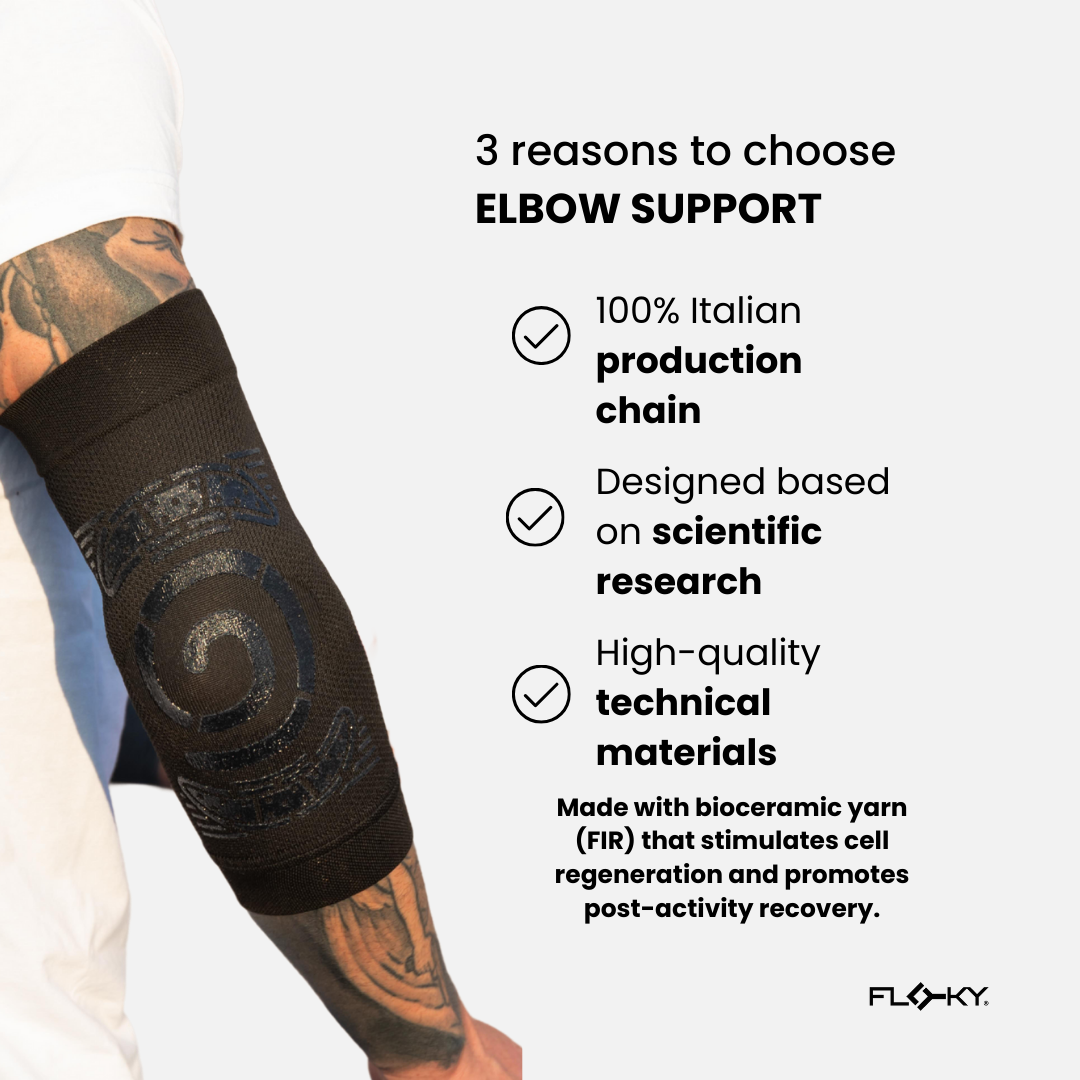
This is where Floky changes the game. Unlike standard compression sleeves that just "squeeze," the Floky NO-STRAIN Sleeve is an active biomechanical device.
It uses a proprietary silicone taping system printed directly onto the fabric. This design mimics the kinesiology taping (KT tape) used by physiotherapists, but in a wearable, reusable format.
How It Stops the Vibration
-
External Taping System: The silicone applications are strategically placed to "offload" the tendon. They absorb the vibration from the paddle before it reaches the epicondyle (the elbow bone).
-
Tendon Stabilization: The sleeve physically holds the muscle fibers in place, preventing the micro-movements that cause inflammation.
-
F.I.R. Technology: The fabric contains bioactive minerals that reflect Far Infrared Rays (F.I.R.) back into the body, improving microcirculation and keeping the joint at an optimal temperature to prevent stiffness.
The "Gear Hack" for Longevity
If you are already feeling the twinge, you don't necessarily have to stop playing (unless the pain is severe—always check with a doctor!). But you do need to change your gear setup immediately.
Try this 2-step protocol:
-
Loosen your grip: Death-gripping the paddle prevents your forearm muscles from absorbing shock naturally. Relax your hand.
-
Wear the NO-STRAIN Sleeve: Put it on before you warm up. The goal is to stabilize the tendon while it's cold and keep it supported through match point.
Click here to shop the Floky NO-STRAIN Sleeve on the official US store.